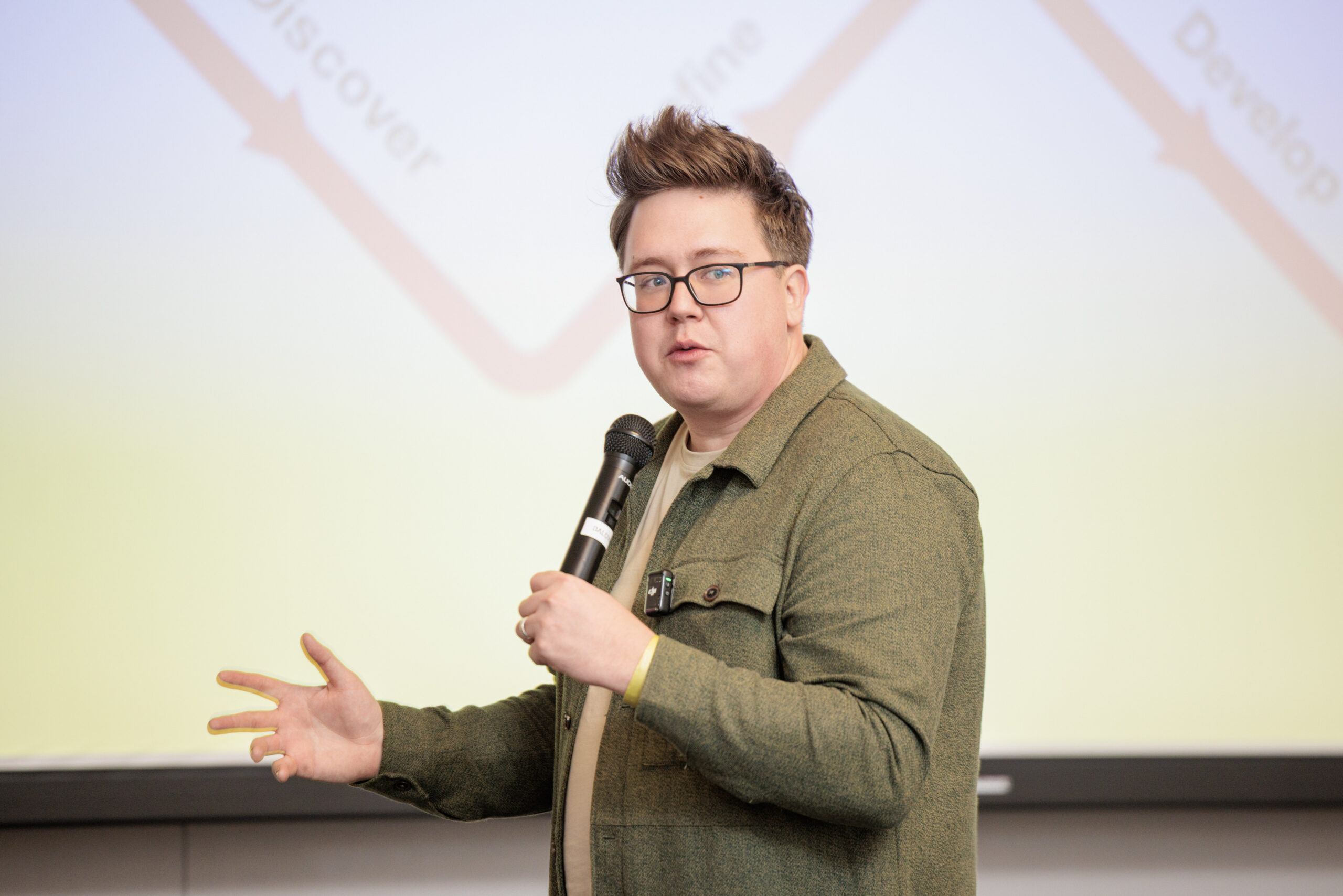
Take 5 is our series spotlighting the people bringing fresh thinking (and the occasional radical opinion) to the world of L&D. This week we’re speaking to Toby Kheng, founder of Freeformers, who called in from South Norfolk on a sunny Friday morning. He is instantly quotable, and very much not here to be diplomatic about the state of L&D.
Meet Toby
Toby Kheng’s company, Freeformers, is a consultancy built on a simple idea: that a better world of work has to be better for the people in it and not just the organisation paying their salaries. After 15 years inside agencies, corporates, and consultancies – as a trainer, learning strategist and commercial director – he concluded that nobody was doing quite what he wanted to do.
Freeformers originally launched around 2015 with a social mission: closing the digital skills gap for staff and young people out of work, eventually reaching 35,000 people across Europe. When the company folded in 2022, Toby acquired the trademark – not completely for sentimental reasons, but because the name carried real integrity and a solid but unfinished mission (and naming things is, in Toby’s words, “frankly hard”). Freeformers evolved mission: a systemic solution which transcends just solving the digital skills gap.
His thinking is commercial as much as it is human. He believes most L&D teams are measuring the wrong things, building expensive bespoke platforms they don’t need, and delivering content nobody asked for – and calling all of it impact.
Toby was also highly commended at the British HR Awards in 2025 for his work in L&D, and we can see why. He’s passionate, warm, self-aware, and truly-people focussed. He’s also hell-bent on rewriting the rules.
Five questions
1. What’s a belief about L&D you held early in your career that you’ve completely changed your mind about?
“That L&D is the best department to deliver learning.” As a Learning Strategy Manager at Currys PC World, Toby was convinced he was the right person to own the learning strategy for his product categories. It took him longer than he’d like to admit to realise that he wasn’t.
“My job really should not have been about creation and management,” he says. “It should have been about the enablement of learning across the organisation. And I think that’s the shift L&D still hasn’t really got over – because it validates its own existence by the amount of stuff it does, because it can’t quantify its impact.”
The trap has real consequences. At a major telecommunications company, Toby was asked to turn a perfectly good PDF into an e-learning module. He refused and left soon after – and doesn’t regret it. Doing pointless work competently just wasn’t going to work for him. “Bold, stupid, whatever… it worked out eventually,” he says with a grin.
The deeper problem, he argues, is that most L&D teams aren’t measuring what actually matters. They track attrition, engagement scores, and training completion rates – none of which tell you whether anyone actually got better at their job, or whether the organisation made more money as a result.
“What most HR people and L&D teams do is deliver stuff that validates their own existence rather than adding value to the individual.”
2. So where does the frustration actually come from?
From fifteen years in the industry – and one very uncomfortable birthday party where Toby’s brother-in-law spent the evening complaining about the worst training he’d ever been made to sit through.
It was something Toby had built himself.
It had won awards. Stakeholders loved it. And nobody, at any point in the process, had actually asked the end users what they needed.
“We just designed and delivered stuff in a bubble,” he says. “It made money, it won awards, and it got great stakeholder feedback – but it completely disregarded what the end user wanted and needed.”
For Toby, that moment crystallised something he’d been ruminating on for years: the L&D industry is brilliant at performing innovation without actually delivering it. Flashy formats, big budgets, lots of self-congratulation at industry events – and very little honest reckoning with whether any of it worked.
“The HR industry and the L&D industry is an incredibly peacocky type industry – it just wants to show off its feathers. It’s all very flashy without really quantifying the impact.”
3. You once spent half your L&D budget on stand-up comedy. What did it teach you about how people actually learn?
At the original Freeformers, every employee was given £1,000 to spend on their own development – the only condition being that they had to justify the business impact. Toby spent half on a behavioural economics course (“dry as crackers, but I still use it”) and the other £500 on a stand-up comedy course, which he justified to his employer as sales training. It was, he admits, a stretch – but they said yes.
Eight weeks, two hours every Wednesday, in a space above an umbrella shop near Tottenham Court Road. The tutor was a comedian, who had no background in L&D whatsoever. At the end, twelve people performed a live comedy set in front of 200 people.
“There were no training videos, there were no PDFs, there were no resources,” says Toby. “She didn’t have a facilitator’s guide, she didn’t have a deck, she didn’t have any experience in L&D at all. Yet over eight weeks she got a group of 12 people to stand up on stage and deliver a comedy set where people actually laughed.”
He later trained as a professional wrestler – 12 weeks, four hours a week, culminating in a match in front of 350 people. A different skill, he says, but mechanically identical. Both had what most corporate training is missing entirely: a community, relentless peer feedback, and a fixed moment where you had no choice but to perform.
“There’s no inflection point where you have to do anything differently. You just consume the content and go, cool, maybe I’ll apply it, maybe I won’t. There’s no real pressure.”
4. If bespoke L&D is so often a waste, what about off-the-shelf compliance training?
Toby is more bullish on it than you might expect. Anti-competition, sexual harassment, anti-bribery: the content is broadly identical across organisations and industries. Building it internally is expensive, unnecessary, and – critically – insulated from any market pressure to be good.
“Why would you employ someone at each of those individual companies to design against the same objective, when you could put all of that resource into one external platform?” he asks. “This is why capitalism works really well – if you’re external, you’ll live or die by how good you are. Whereas an internal L&D person delivering a captive-market workshop, it doesn’t matter if it’s any good or not. It’s like: well, we only had that one available.”
His wife once lost an entire day to completing her company’s compliance training, and was miserable for the rest of the evening. Toby, out of curiosity, checked out the course. It had been built internally.
The principle he keeps coming back to: internal L&D resources should be spent on what only that organisation can build – not on reinventing what already exists perfectly well off the shelf.
“An L&D person inside a company should be focusing on the things that are so bespoke to that company that they could not possibly purchase them anywhere else.”
5. If Freeformers has the impact you’re hoping for, what does that look like in three years’ time?
Toby is unsentimental about the limits of consultancy as a vehicle for change. Scaling into a large firm isn’t the answer – he’s spent enough time around big consultancies to know what they actually are.
“Grow a massive consultancy? I don’t want to do that,” he says. “I’ve worked with enough of them. They’re generally just great big pyramid schemes dressed up as professional services firms.”
The lever he’s betting on instead is measurement. Specifically, a concept he calls Mutual Lifetime Value: tracking the give and take between employer and employee over time – including after people leave. If someone exits your company and becomes a customer, refers a hire, or advocates for your brand, that’s real commercial value. Attrition as a metric, by contrast, is nearly useless – people are going to leave regardless. The question is whether they leave as advocates or as cautionary tales.
If people teams start using Mutual Lifetime Value as a north star – and can use it to make a hard commercial case for treating employees well – then the change, he argues, scales itself.
“What’s measured is managed. If you can prove that treating your people better makes companies more money, given that data, de facto you have no other choice but to treat your people better.”

Take 5 is a series by Staff Skills academy+ spotlighting the people bringing fresh thinking and the occasional radical opinion to the world of learning and development.
If you found this interesting, there’s more where it came from – get our monthly round-up sent straight to your inbox. Sign up here.