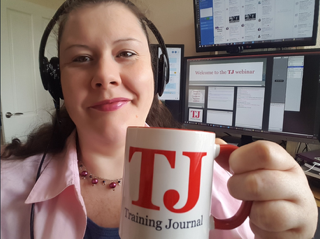
Take 5 is our series spotlighting the people bringing fresh thinking (and the occasional radical opinion) to the world of L&D. This week we spoke to Jo Cook, founder of Lightbulb Moment and editor of Training Journal, who joined us from her home office on a warm June afternoon. She’s precise, funny, and forensically incapable of letting a bad stat go unquestioned.
Meet Jo
Jo Cook is the founder of Lightbulb Moment, an L&D consultancy specialising in training design, facilitation, and virtual and hybrid delivery. She’s been running it for 13 years – not entirely by plan. A chronic long-term health condition made the Monday-to-Friday 9-to-5 unworkable, so she did what any determined L&D professional would do: went out on her own to do things her way.
The name of her business came to her one morning, half-awake in her mother’s spare room, when she had a literal lightbulb moment. She now has lightbulb mugs, lightbulb motifs, and a lightbulb vase her partner bought her. The metaphor is not incidental. The thing Jo loves most, and the thing that’s driven 13 years of independent work, is the penny-drop moment.
She also writes the weekly TJ News Flash for Training Journal, which means she reads more L&D press releases, research papers and dubious stats than your average Jo, and has developed a finely tuned instinct for when something doesn’t add up.
Jo is warm, direct and deeply sceptical of anything presented as evidence without proper scrutiny. We liked her right away.
Five questions
1. What’s a belief about L&D you held early in your career that you’ve completely changed your mind about?
Jo’s quick to say, “Learning styles”. Growing up, she was labelled a ‘visual learner’, which implied she’d only be successful if that’s the way she was taught. But this wasn’t entirely correct.
“A lot of these myths feel so intuitively right at first,” she said, referencing that she genuinely can’t navigate without picturing the route in her head. Visual learner: case closed, apparently. Except that during her journalism training she’d often put down her pen and just listen, fully absorbed. And there are also plenty of practical things she can only learn by doing them wrong several times first. Which would make her – depending on the moment – a visual learner, an auditory learner and a kinaesthetic learner. “In other words,” she says, “a normal human.”
The shift came when she studied psychology through the Open University and became fascinated by empirical evidence. That rigour became, in her words, “The icing on the cake of my curiosity.” Once she started applying that lens to L&D, a lot of things stopped holding up.
“The methodology was telling me: you are one thing and you do it best this one way. But I knew from my practical experience that wasn’t always true. There was that tension.”
2. Bad science spreads fast in L&D. Why doesn’t the profession push back harder?
Because it’s useful. That’s the uncomfortable answer, and Jo gives it without hesitation.
There’s an often-misquoted statistic claiming 93% of communication is non-verbal. There’s also no solid, traceable source to back up the idea that 65% of people are visual learners. Yet, L&D professionals frequently quote both, with confidence.
These sorts of stats give us language. It lets us sell a model in a training room, justify a decision to a stakeholder, or make something feel simple. “Humans are messy. Learning is messy. Work is messy. So if you’ve got something that says X this, Y that, Z the other – that’s really nice.”
There’s also a social cost to pushing back. Depending on who’s in the room, calling out shaky evidence can make you look difficult, negative or superior.
But the stakes are real. L&D budgets are perennially the easiest line to cut. The department can be seen as woolly, hard to measure, and suspiciously fond of expensive away days. The antidote, Jo argues, is evidence-informed credibility, and credibility starts with evidence.
“If you’ve got a department that’s credible and increasing performance, in whatever way that looks like, you’re not going to cut that budget. You’re going to say: I want more of that.”
3. How do you actually know when training has worked – rather than people just saying they enjoyed it?
This is one of the industry’s biggest unresolved challenges, and Jo answers it in layers.
First: you can’t know this at the end of a session. You just can’t. Even if someone nails a practice activity in the room, that’s “practice with scaffolding and feedback” – which is meaningfully different from sitting at their desk on Monday morning, facing the actual thing. Feedback forms tell you someone had a good time. Confidence scores tell you someone feels better. Neither tells you whether anything changed in their day-to-day work.
Second: Jo isn’t dismissing in-session signals entirely. When someone’s feedback mentions a specific activity that made them think differently, or they describe a learning nugget in a way she hadn’t anticipated, that’s useful. It’s not the main story, but it’s a real signal.
Third: the data that actually matters is often data that L&D teams can’t easily access. Jo’s clear on this point. She once delivered training for a business that, when she asked how they’d measure whether she’d been successful, said: “We’ll kind of just know.” That’s not good enough – not for the client, and not for Jo.
“How do you know I’ve done a good job? And if I don’t do a good job, how do you know whether to blame me or to blame something else?”
4. You think that there’s still a lot of organisations that could improve their virtual and hybrid training. What are they getting wrong?
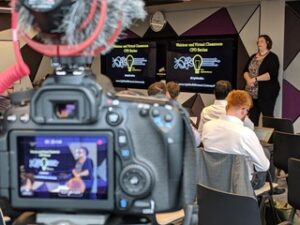
The core mistake, Jo says, is treating virtual training as a logistics problem rather than a design problem. Most organisations’ approach to going virtual was: open Zoom, share the PowerPoint, cram in more people, cut the questions. Which takes a potentially mediocre face-to-face training session and removes all the best bits, making it lack the experience we need for learning.
Virtual isn’t the problem. It simply magnifies whatever was already there, good or bad.
“If your training approach is ‘come in with a slide deck and talk at people’ – doing that on Zoom is going to make it even worse.”
She’s also wary of the opposite trap: conflating ‘activity’ with ‘engagement.’ Someone clicking on a poll or typing in a chat is physically occupied – but they’re not necessarily listening. Clicks are not cognition. Real engagement might look like someone sitting back with their arms crossed, thinking hard about something they disagree with.
Her train-the-trainer programmes always start with the basics of virtual delivery – even for people who will never personally run a session. Because if a designer doesn’t understand what a facilitator actually has to do, they’ll design something that looks great on paper but falls apart in the room. She uses the analogy of a 3D-printed trophy: the designer made it beautiful, the printer couldn’t print it, and neither person knew enough about the other’s constraints to fix it.
“You get what looks good on paper, but then the person comes to their physical or virtual classroom and goes: what am I supposed to do with this mess?”
5. Off-the-shelf compliance training – is it a helpful tool?
“There is no bad modality,” she says, diplomatically.
The problem isn’t the format. The problem is that ‘off-the-shelf compliance training’ gets deployed as the answer before anyone has properly diagnosed the question. For example: a company decides it needs working at heights training because staff keep falling off ladders… But if you actually went and talked to the people falling off ladders, you might find out it’s because clients’ dogs keep running out and startling them. Which isn’t a training problem, it’s a customer service problem.
“The answer isn’t always training. Often other things need addressing too.”
She applies the same logic to the ongoing debate about whether companies need to build bespoke L&D platforms. We talked about a council putting out a £4 million tender to build a platform from scratch. Her instinct: run a proper needs analysis first. You might find that £1 million spent updating your Excel processes would move the needle further than any platform ever could.
“The answer isn’t always the thing you came in to buy.”
Jo’s key takeaway: don’t fall into the leadership trap
The key message Jo wants L&D leaders to take away from this conversation is: develop yourselves. Don’t get so caught up in training others that you neglect your own development.
Why? Because Jo has noticed that people in L&D are often brilliant at developing everyone else, yet quietly terrible at working on themselves. Which means they don’t build the skills required to influence senior stakeholders, speak the language of the business, or make a commercial case for what they want to do. Without those skills and experience, L&D teams can struggle to secure the influence and support they need, regardless of how good their training is.
The budget gets cut, the team shrinks, and the impact never scales.
“Develop ourselves, to develop others, to support the organisation and the individuals within it. That’s the goal.”
Underpinning almost everything Jo said was a simple principle: stay curious. About people, about evidence, and about whether the obvious answer is actually the right one.
Take 5 is a series by Staff Skills academy+ spotlighting the people bringing fresh thinking and the occasional radical opinion to the world of learning and development.
If you found this interesting, there’s more where it came from – get our monthly round-up sent straight to your inbox. Sign up here.